2026 AI Data Engineer Roadmap

In 2024, a mid-level data engineer could coast on knowing Airflow, writing decent SQL, and fixing pipelines when they broke. That was a $140k job.
In 2026, it's...different. Not because AI "replaced" those engineers, but because the definition of "good enough" moved dramatically upward
➡️ When AI generates code in seconds, the bottleneck isn't writing code anymore — it's knowing whether the code is correct. And "correct" doesn't mean "runs without errors." It means:
- Does this transformation preserve the business logic that 3 teams rely on?
- Will this work when we backfill six months of data?
- Does this handle the edge case where European users have NULL country codes?- Is this actually cheaper to run than what we had before, or did Claude just write a beautiful cross-join that'll cost $40k/month?
AI made the *floor* of code quality rise. That's great.But it also made the *ceiling* of what's expected from a data engineer rise with it.
Here are real 2026 challenges Data Engineers are facing:
→ Every department is launching AI initiatives with zero governance
→ Data platform costs tripled because agents hammer your warehouse with unoptimized queries
→ Three different AI systems have three different interpretations of what "active customer" meansOkay.
But what actually keeps you safe?
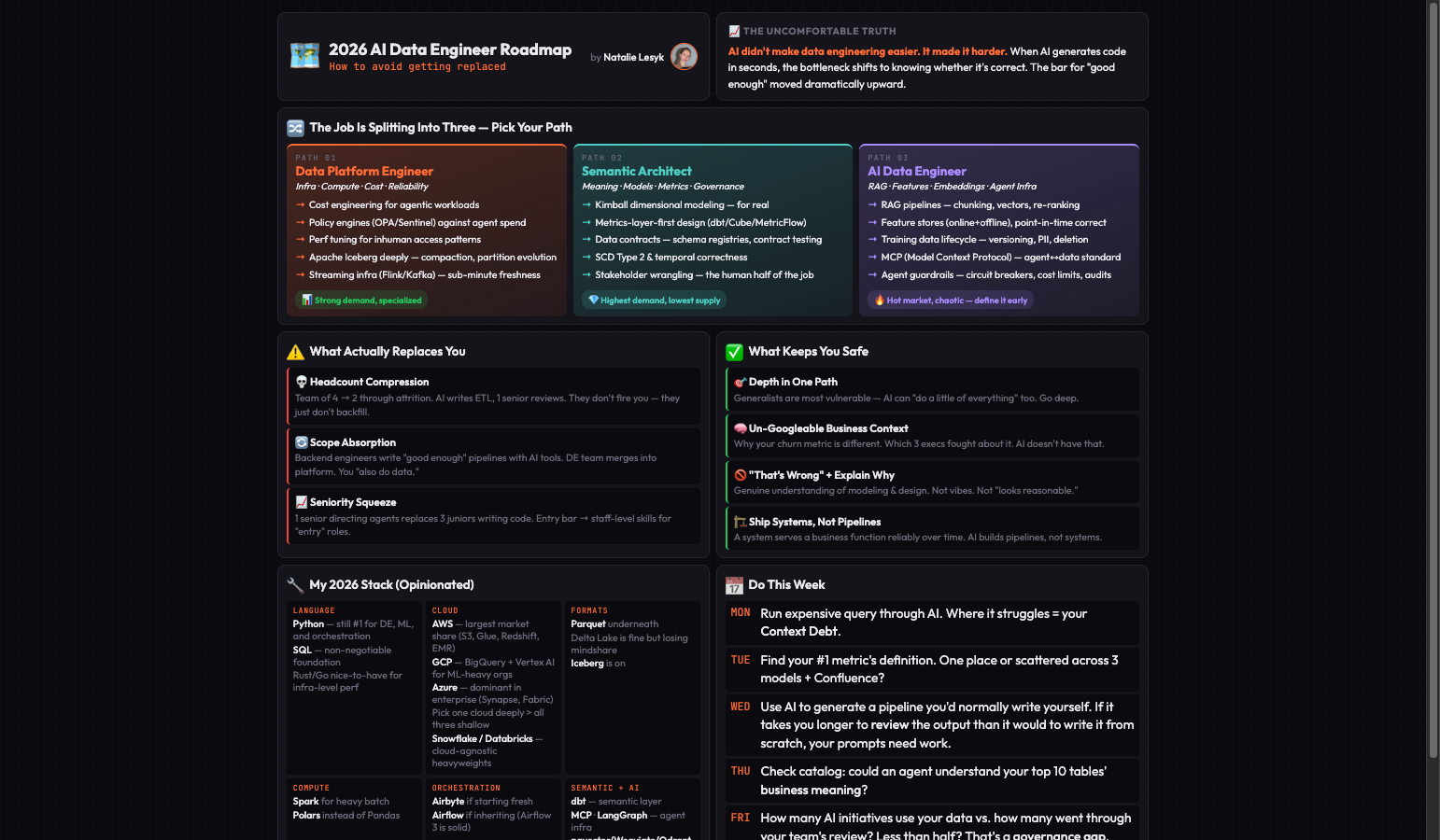
✸ Depth in one path. Generalists who "do a little of everything" are the most vulnerable - because AI can do that too
✸ Business context that can't be Googled. If you know WHY your churn metric is calculated differently than the industry standard, that knowledge is irreplaceable
✸ The ability to say "no, that's wrong" to AI output - and explain why
✸ System design and best practices - hellooo data modelling, idempotency,compression, partitioning, etc
Check my infographic for the details -> Follow for Part 2!